
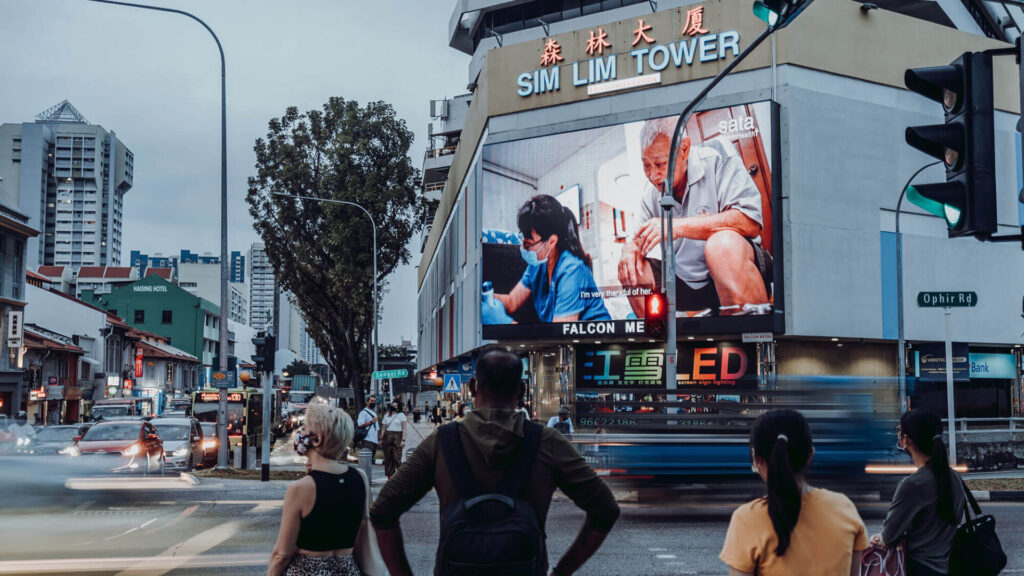
Photo source: Plan B Media
Executive Summary
- Singapore’s Advertising Activities sector (SSIC 73100) remains a structurally important component of the country’s knowledge-intensive service economy, supported by Singapore’s role as a regional headquarters and brand management hub.
- Between 2022 and 2024, the sector recorded strong revenue expansion, with industry revenue reaching USD 3.92B in 2024, corresponding to Revenue CAGR 24.7% (2022-2024). Growth was primarily driven by the normalization of corporate marketing expenditure and sustained shifts toward digital and performance-driven advertising models.
- Cost dynamics remained stable, with COGS CAGR 2.5%, highlighting the sector’s asset-light and scalable operating structure. Profitability trends indicate financial stabilization, as operating losses narrowed while the industry returned to positive Net Profit (USD 37.31M).
- Overall, sector performance reflects recovery-cycle normalization and earnings stabilization, rather than structural capacity expansion.
Industry Snapshot 2024
Singapore’s Advertising Activities sector (SSIC 73100) exhibits the characteristics of a mature, high-value professional service industry, operating within one of Asia’s most concentrated corporate and brand management environments. The sector comprises advertising agencies, integrated marketing communication firms, branding consultancies, and media strategy providers serving both domestic and regional markets.
In 2024, companies classified under SSIC 73100 generated total industry revenue of approximately USD 3.92B, reflecting Revenue CAGR 24.7% (2022-2024). The revenue trajectory highlights the continued recovery of corporate marketing investment and the structural expansion of digital and performance-oriented advertising channels.
During the same period, COGS reached approximately USD 46.46M, corresponding to CAGR 2.5%. The relatively muted cost expansion compared with revenue growth underscores the sector’s scalable cost structure, where topline growth is not constrained by proportional increases in direct operating costs.
At the net level, the industry reported positive net profitability of USD 37.31M, marking a notable improvement from the losses observed in 2022. This shift signals easing financial pressures and gradual normalization of sector-wide earnings dynamics.
As of 2024, 248 companies were active under SSIC 73100, illustrating the sector’s competitive depth and Singapore’s continued role as a regional base for marketing and communication services.
Industry Characteristics & Operating Landscape
Where do companies typically operate?
Advertising and marketing service providers in Singapore are heavily concentrated within the country’s corporate, financial, and commercial districts, closely aligned with multinational headquarters, regional management centers, and innovation-driven business clusters.
Singapore’s economic structure positions the sector as a regional coordination and decision-support industry, where firms frequently manage cross-border campaigns, brand strategies, and integrated marketing programs extending beyond the domestic market. Demand formation is therefore influenced less by population scale and more by corporate density and regional business activity.
This geographic and functional concentration reinforces Singapore’s structural advantage as a strategic command and brand management hub within ASEAN.
What drives demand in this sector?
Demand within SSIC 73100 is fundamentally shaped by corporate investment cycles, competitive dynamics, and structural shifts in consumer engagement channels.
Key demand drivers include the expansion of regional headquarters activity, continued migration toward digital and performance-driven advertising, growth of platform and e-commerce ecosystems, and rising corporate competition for consumer attention and brand differentiation.
Unlike domestically anchored industries, advertising demand in Singapore is strongly correlated with business confidence, innovation cycles, and regional brand investment patterns, reflecting the city-state’s role as a center for strategic and managerial decision-making.
What defines the operational model?
Advertising activities operate under a predominantly human-capital-intensive, asset-light economic structure, characterized by flexible cost components, limited physical asset dependency, and revenue sensitivity to client budgets and campaign cycles.
Profitability dynamics are influenced more by talent costs, service mix, client concentration, and pricing models than by capacity utilization. As a result, revenue growth can generate disproportionate margin effects when supported by cost discipline and favorable client economics.
The substantial divergence between Revenue CAGR 24.7% and COGS CAGR 2.5% highlights the sector’s inherent operating leverage mechanics.
Interpreting 2022-2024 Performance
Revenue expansion between 2022 and 2024 primarily reflects post-disruption normalization dynamics, including the rebound of corporate marketing expenditure and structural reallocation toward digital and measurable advertising channels.
The comparatively slow rise of Cost of Goods Sold relative to revenue suggests improving operating efficiency and scale effects, where more creative, value-adding works are delivered by fewer employees.
Operating profit trends indicate loss compression rather than full margin normalization, signaling that competitive pressures, wage dynamics, and pricing structures continue to shape sector profitability. Meanwhile, the return to positive Net Profit underscores easing financial pressures and stabilization of earnings structures.
Overall, sector performance reflects a transition from recovery phase toward earnings rebound.
What This Means for Investors
- For investors and market observers, Singapore’s Advertising Activities sector (SSIC 73100) provides exposure to a regionally integrated, knowledge-intensive service industry positioned at the intersection of technology, media evolution, and corporate strategy.
- Key considerations include revenue linked to corporate spending behavior, margin sensitivity to talent and wage dynamics, competitive intensity, and the accelerating shift toward data-driven and performance-based advertising models.
- Companies best positioned for long-term resilience are those capable of sustaining strong pricing, client diversification, analytical capabilities, and operational efficiency. In an increasingly capability-driven competitive landscape, value creation depends less on scale alone and more on strategic differentiation and measurable effectiveness.
- Singapore’s advertising industry therefore reflects the economics of a high-skill, high-competition service sector, where performance is determined by adaptability, client economics, and execution capabilities rather than linear growth alone.
About Datagent
Datagent is the trusted intelligence partner for company data and insights across Southeast Asia and beyond. We combine firmographics, financials, macro and micro economics into one integrated dataset — helping organizations uncover opportunities, assess markets, and make smarter, data-backed decisions across 11 dynamic economies.
Datagent provides a total of 61 firmographic data fields, comprising 22 non-financial, and 39 financial indicators with coverage spanning 2022–2024.
This report is for informational purposes only and does not constitute financial advice or an invitation to invest. Decisions should be based on independent research and professional consultation to avoid any unintended liabilities.