
BANGKOK ZONING REGULATIONS 2026: A GUIDE FOR UNLISTED DEVELOPERS
Bangkok zoning regulations 2026 and Thailand property zoning frameworks is critical for any investor, corporate development team, or unlisted developer in Thailand evaluating Bangkok’s real estate sector in 2026. The Bangkok Comprehensive Plan—the master regulatory document that every property development regulations Thailand analysis begins with—divides the capital into residential, commercial, industrial, and mixed-use zones under the Town Planning Act Thailand B.E. 2518. However, Datagent’s Q1 2026 property intelligence audit reveals that the operational reality of Bangkok zoning regulations 2026 for unlisted firms runs 20% to 35% more complex than published summaries suggest.

The gap comes from three structural friction points: localized ministerial regulation overlays that modify base zoning permissions at the sub-district level, Environmental Impact Assessment (EIA) triggers that apply asymmetrically to firms lacking established regulatory track records, and the practical documentation burden that Bangkok Metropolitan Administration (BMA) offices impose on developers without SET-listed compliance histories. As documented in our Thailand Real Estate Sector (TSIC 68), the sector contracted from 2,788 companies in 2022 to 2,667 in 2024—with unlisted developers who underestimated Bangkok zoning regulations 2026 accounting for a disproportionate share of exits.
1. Why Your Bangkok zoning regulations 2026 Analysis Misses Real Property Development Costs
I have spent the better part of a decade advising institutional investors, PE funds, and corporate development teams on what it actually takes to navigate Thailand property zoning and move a real estate development from concept through permitting in Bangkok. Family offices running due diligence on unlisted Thai developers. Strategy consultants building expansion models for regional hospitality groups. Growth equity funds evaluating brownfield conversion opportunities. The common thread: nearly all of them arrive with a zoning model that treats the Bangkok Comprehensive Plan as a static, self-contained rule set—and it is not.
The Bangkok Comprehensive Plan establishes zoning categories Bangkok developers must work within. But the actual construction permit Bangkok requirements are modified by Ministerial Regulations under the Town Planning Act Thailand that specify floor area ratio Thailand limits, building height restrictions Bangkok caps, setback requirements, and density controls at the sub-district (khet) level. The new Bangkok city plan 2026, approved by the Bangkok City Planning Committee in April 2026 and expected to take effect around September 2027, will further reshape these Bangkok zoning regulations 2026 that developers rely on for project planning.
2. Bangkok Zoning Categories: FAR Limits, Height Restrictions, and Color Codes Explained
2.1.Understanding Color Codes under Bangkok Zoning Regulations 2026
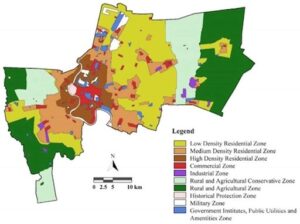
Bangkok’s land use regulations Thailand framework classifies land using a color-coded system. Each category within Bangkok zoning regulations 2026 carries specific FAR limits Bangkok developers must comply with, along with building height restrictions Bangkok that determine maximum development density:
| Zone Category | Color | Max FAR | Height Limit | Density Cap | Unlisted Dev Impact |
| Low-Density Residential | Yellow (Y) | 3:1 – 4:1 | 12-15m | Low | Townhouse / low-rise only |
| Med-Density Residential | Orange (O) | 5:1 – 6:1 | 23-36m | Medium | Mid-rise condo viable |
| High-Density Residential | Brown (B) | 6:1 – 8:1 | Varies by khet | High | Fastest unlisted growth |
| Commercial Core | Red (R) | 8:1 – 10:1 | No cap (EIA) | Very High | Highest complexity |
| Industrial | Purple (P) | Varies | Per EIA | Industrial only | EEC preferred route |
| Conservation / Green | Green (G) | 1:1 – 2:1 | 9-12m | Minimal | Development restricted |
Dataset Provenance: Compiled via Datagent Property Intelligence Platform, Q1 2026. FAR ranges reflect observed permitted densities across active BMA permit applications, cross-referenced with Ministerial Regulation overlays at the khet level.
2.2. How Floor Area Ratio Thailand Limits Determine Your Project Viability
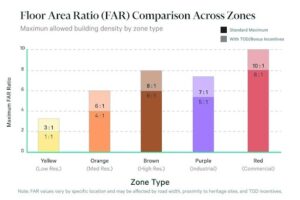
The floor area ratio Thailand developers must comply with is the single most impactful variable within Bangkok zoning regulations 2026 for project economics. A one-rai plot in Sukhumvit with commercial zoning Bangkok classification (Red zone, FAR 10:1) supports approximately 16,000 sqm of gross floor area—while the same plot with residential zoning Bangkok classification (Yellow zone, FAR 3:1) supports only 4,800 sqm. This 3.3x GFA differential translates directly into a 3x to 5x land value differential, making FAR limits Bangkok the primary driver of Thailand bank valuation.
For unlisted developers evaluating land acquisition in Bangkok, confirming the exact floor area ratio Thailand that applies to a specific parcel requires checking not just the Bangkok Comprehensive Plan base classification, but the Ministerial Regulation overlay at the sub-district level. A commercial Red zone in Silom may carry fundamentally different FAR limits Bangkok than an identically classified Red zone in Ratchada, based on infrastructure capacity assessments and transport corridor designations.
3. EIA Requirements Thailand Real Estate: The Approval Timeline That Breaks Unlisted Developer Budgets
3.1. When Do EIA Requirements Thailand Trigger for Property Development?
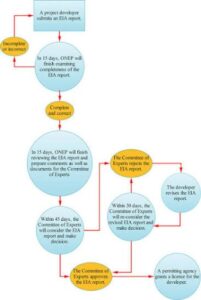
Under the Environmental Quality Promotion and Protection Act B.E. 2535, developments exceeding certain thresholds trigger mandatory environmental review. These EIA requirements Thailand imposes create the most significant timeline differential between listed and unlisted developers:
-
Residential projects: EIA triggered at 80 units or buildings exceeding 23 meters in building height restrictions Bangkok.
-
Commercial developments: triggered at 10,000 sqm of floor area.
-
Mixed-use development Bangkok projects: assessed based on the dominant use classification, with crossover thresholds creating additional review complexity.
For SET-listed developers with established ONEP relationships and standardized submission templates, EIA approval timelines average 4 to 7 months. For unlisted developer Thailand firms without regulatory track records, our field data shows approval timelines averaging 8 to 14 months—roughly double. This extended timeline generates direct land bank holding costs that erode Thai developer EBITDA margins by 300 to 500 basis points.
3.2. Construction Permit Bangkok: The BMA Documentation Burden
The BMA construction permit process requires comprehensive documentation including architectural plans, structural engineering certifications, fire safety compliance, and utility connection confirmations. For unlisted developer Thailand firms, the construction permit Bangkok burden is compounded by additional requirements: audited financial statements for the preceding three years, land title verification chains, and construction bond arrangements.
The real estate permit Thailand cost for an unlisted developer’s first Bangkok project typically ranges from USD 50,000 to USD 120,000 in direct regulatory compliance costs. But the indirect cost—the extended land development permit Thailand timeline generating holding expenses—frequently exceeds this by 3x to 5x. Listed developers maintain standing documentation packages; unlisted developers build from scratch, adding 6 to 12 weeks to the construction permit Bangkok timeline.
4. EEC Zoning Regulations vs. Bangkok Zoning Regulations 2026
The Eastern Economic Corridor operates under separate EEC zoning regulations Thailand with streamlined permitting designed to attract industrial and logistics investment. Development approvals process 40% to 60% faster than equivalent Bangkok submissions, with reduced EIA scope for BOI-promoted investment categories.
For Bangkok zoning for foreign developers seeking lower-friction market entry, EEC zones offer a structurally simpler regulatory pathway—though land prices have appreciated 25% to 40% since 2022 as early movers have priced in this advantage. The tradeoff between simplified EEC zoning regulations Thailand and higher Bangkok land values with complex Bangkok zoning regulations 2026 requires careful corridor-specific analysis.
5. Strategic Interventions: How to Navigate Bangkok Zoning Regulations 2026 as an Unlisted Developer
5.1. Pre-Acquisition Regulatory Mapping for Thailand Property Zoning
Before acquiring land, commission a comprehensive regulatory overlay analysis covering the specific Ministerial Regulation modifications, EIA triggers, and BMA documentation requirements for your target site. This investment—USD 15,000 to USD 30,000—prevents land acquisition decisions based on incomplete Bangkok zoning regulations 2026 assumptions that generate 10x downstream costs.
5.2. Regulatory Counsel for Bangkok Zoning Regulations 2026 Compliance
Engage Bangkok-based law firms with active BMA permitting practices before your first land development permit Thailand submission. Institutional knowledge reduces average construction permit Bangkok approval timelines by 30% to 40%. For Bangkok zoning for foreign developers, firms with dual Thai-English capacity and cross-border structuring experience are essential for managing Thailand REITs.
5.3. Phased Development under Bangkok Zoning Regulations 2026
Structure projects to remain below EIA thresholds where viable—sub-80 units residential, sub-10,000 sqm commercial. Where scaling requires exceeding building height restrictions Bangkok thresholds, begin EIA pre-consultation concurrently with land acquisition due diligence, not sequentially.
6. Frequently Asked Questions
6.1. How do Bangkok zoning regulations 2026 affect property development?
Bangkok zoning regulations 2026 establish base land use classifications—residential, commercial, industrial, mixed-use—each with designated FAR limits Bangkok caps, building height restrictions Bangkok, and setback requirements under the Bangkok Comprehensive Plan. For unlisted developer Thailand firms, the practical impact extends beyond base classifications because Ministerial Regulations under the Town Planning Act Thailand modify permissions at the sub-district level. The new Bangkok city plan 2026 will further reshape zoning categories when it takes effect around September 2027.
6.2.What are the FAR limits in Bangkok for residential and commercial zones?
The floor area ratio Thailand limits in Bangkok range from 3:1 to 4:1 for low-density residential zoning Bangkok (Yellow zones), 5:1 to 6:1 for medium-density (Orange zones), 6:1 to 8:1 for high-density and mixed-use development Bangkok (Brown zones), and 8:1 to 10:1 for commercial zoning Bangkok (Red zones). These FAR limits Bangkok determine maximum buildable area and directly drive land bank economics.
6.3. How long does the EIA approval process take for real estate in Thailand?
EIA requirements Thailand mandate environmental review for residential developments exceeding 80 units or 23 meters height. For listed developers with established ONEP relationships, approval averages 4 to 7 months. For unlisted developer Thailand firms, the timeline extends to 8 to 14 months. The key intervention is beginning EIA pre-consultation concurrently with land acquisition due diligence as part of your overall Thailand real estate investment strategy.
6.4. What does the construction permit Bangkok process cost for unlisted developers?
Direct real estate permit Thailand costs typically range from USD 50,000 to USD 120,000. However, the indirect cost from extended timelines—generating land bank holding expenses during the land development permit Thailand approval process—frequently exceeds direct costs by 3x to 5x.
6.5. How do EEC zoning regulations compare to Bangkok zoning regulations 2026 for unlisted developers?
EEC zoning regulations Thailand process 40% to 60% faster than equivalent Bangkok submissions. For Bangkok zoning for foreign developers evaluating market entry, EEC offers structurally lower regulatory friction. The optimal choice depends on your target asset class: industrial and logistics favor EEC; residential and commercial typically require Bangkok despite the more complex Bangkok zoning regulations 2026 framework.
If your financial model for Thailand real estate is built on generic industry reports, it is likely missing the ground-level data that separates viable opportunities from underperforming assets. Book a 15-minute call with Datagent’s real estate analytics team to receive a framework calibrated to your specific investment thesis.
Written by: Jey Nguyen, Senior Analyst at Datagent | [email protected]
About Datagent
Datagent is the trusted intelligence partner for company data and industrial insights across Southeast Asia and India. We integrate firmographics, verified corporate financial performance, and localized micro-economic indicators into a single, structured intelligence layer – helping institutional investors, multinational corporations, and strategy consultants mitigate supply chain risk and accelerate investment decisions across 11 dynamic economies.
Datagent delivers a total of 61 core firmographic fields, comprising 22 operational variables and 39 standardized financial indicators, with full historical coverage across 2022-2024.