

Executive Summary
The Manufacturing of Motor parts and Accessories industry in Vietnam (VSIC 2930) is scaling into a strategic sector, supported by 931 companies and strong capital deployment linked to Chinese and Korean OEM expansion.
Financial momentum strengthened in 2022–2024, with Net Revenue CAGR +13% and Net Profit CAGR +17%, driven by localization and higher capacity utilization.
Chinese and Korean investment is the primary growth driver, especially in EV-related parts, precision metal components, and hybrid mechanical–electrical assemblies.
Vietnam is evolving into a regional supply-chain hub, shifting the industry from cost-based manufacturing toward higher technical and investment intensity.
Industry Snapshot 2024
The Manufacture of Motor Parts and Accessories sector in Vietnam represents a diverse group of companies supplying components across automotive, motorcycle, machinery, and supporting industries. Datagent’s 2024 filings show 931 companies registered in this category, with a combined Total Registered Capital of 1,689,779,661 USD.
According to reported submissions, companies in this VSIC generated a Total Operating Revenue of 4,137,745,208 USD in 2024. After adjustments, the sector recorded Total Net Revenue of 3,662,960,339 USD, reflecting a CAGR of +13% from 2022.
Profit outcomes varied, with the category posting a Total Gross Profit of 680,396,880 USD and a Total Net Profit for the period of 426,974,726 USD, equivalent to a CAGR of +17% compared with 2022. On the balance sheet, the sector held Total Assets of 5,372,876,376 USD, supported by Total Equity of 2,810,638,371 USD across filing companies.
Industry Characteristics & Operating Landscape
Where do companies in this VSIC typically operate?
Motor parts and accessories manufacturers are heavily concentrated in industrial hubs that host major Chinese and Korean automotive and motorcycle suppliers. Key clusters include:
- Bac Ninh, Hai Phong, Vinh Phuc – home to extensive Korean (Hyundai, Kia) and Japanese-led supplier networks, alongside growing Chinese Tier-1 and Tier-2 clusters.
- Binh Duong, Dong Nai, Ho Chi Minh City – longstanding bases for machining, moulding, and stamping firms supporting global OEMs, including major Korean electronics–automotive hybrids.
- Thai Nguyen and Thanh Hoa – emerging destinations tied to China+1 relocation, especially for precision engineering and metal components.
These locations mirror Vietnam’s strategy of integrating deeper into East Asian automotive and industrial supply chains.
What drives demand in this sector?
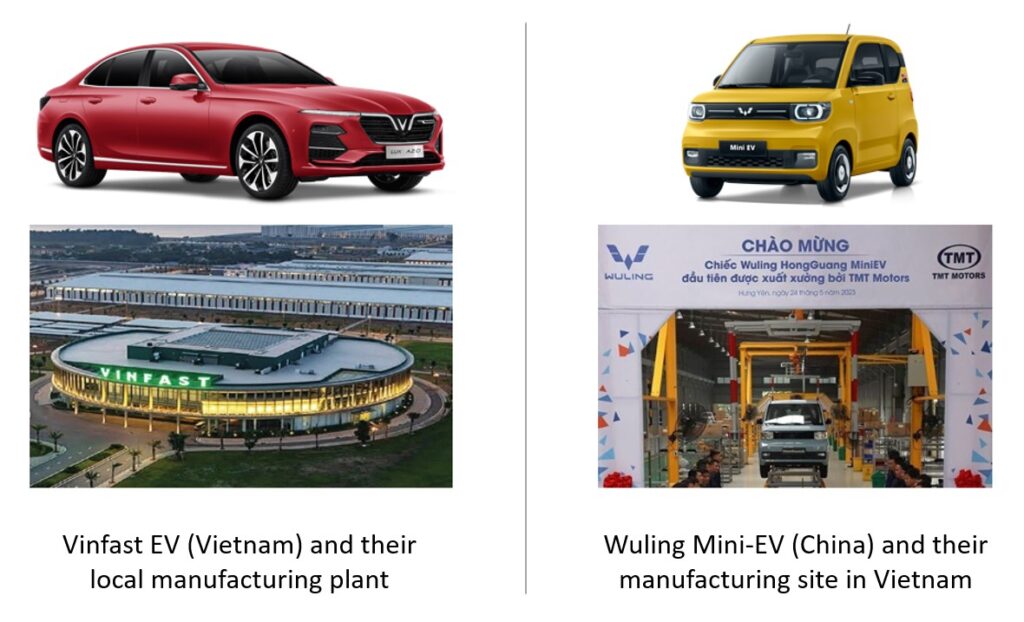
Demand for motor parts in Vietnam is increasingly shaped by the expansion of Chinese and Korean manufacturers, who are accelerating investment in localized production to reduce reliance on China and capture ASEAN market access.
Key drivers include:
- Rising localization requirements from Korean and Chinese automotive OEMs operating or expanding in Vietnam.
- Growth of Vietnam’s motorcycle and electric two-wheeler market, where Chinese battery, motor, and drivetrain suppliers are gaining share.
- Integration into Korean-led EV and electronics ecosystems, particularly in components for sensors, control modules, and metal housings.
- FDI inflows from China and Korea seeking more resilient supply-chain diversification under the China+1 strategy.
Vietnam’s competitive labor costs, proximity to southern China, and strong FTAs make it a preferred base for these investors.
What defines the operational model?
Operations in this sector are machinery- and precision-intensive, often requiring investment aligned with Korean and Chinese OEM technical standards. Many firms operate within Tier-1 or Tier-2 supply chains, where long-term contracts, process certifications, and quality consistency are critical to maintaining supplier status.
Partnerships or joint ventures with East Asian firms are increasingly common, particularly in stamping, casting, CNC machining, injection molding, and electronic subcomponent production.
Interpreting the 2022-2024 Totals
The strong CAGR in revenue and profit demonstrates the momentum created by expanding Chinese and Korean supplier ecosystems in Vietnam. As these OEMs scale up production capacity and shift more components out of China, the local supplier base has seen rising orders, stronger utilization rates, and more capital deployment.
The significant asset base reflects ongoing investment into tooling, machinery, mold fabrication, and plant expansions – many of which are financed or supported by East Asian parent companies.
Overall, the 2024 totals reinforce that VSIC 2930 is moving from a traditional component sector into a strategic supplier hub within the China–Korea–Vietnam supply chain triangle.
What This Means for Investors
For investors, the presence of large Chinese and Korean manufacturers creates both opportunities and competitive pressure. Firms with proven technical capabilities, stable OEM relationships, and capacity for automation or precision upgrades are increasingly attractive targets.
Growth areas include:
- High-precision metal parts
- EV-related subcomponents (motors, housings, electronics)
- Hybrid mechanical-electrical parts aligned with Korean OEMs
- Components supporting Chinese two-wheeler and EV expansions
Investors should monitor upstream capital injections from Chinese and Korean groups, as these often catalyze downstream growth among local and joint-venture suppliers.
About Datagent
Datagent is the trusted intelligence partner for company data and insights across Southeast Asia and beyond. We combine firmographics, financials, macro and micro economics into one integrated dataset — helping organizations uncover opportunities, assess markets, and make smarter, data-backed decisions across 11 dynamic economies.
Datagent provides a total of 61 firmographic data fields, comprising 22 non-financial, and 39 financial indicators with coverage spanning 2022–2024.
This report is for informational purposes only and does not constitute financial advice or an invitation to invest. Decisions should be based on independent research and professional consultation to avoid any unintended liabilities.