
Executive Summary
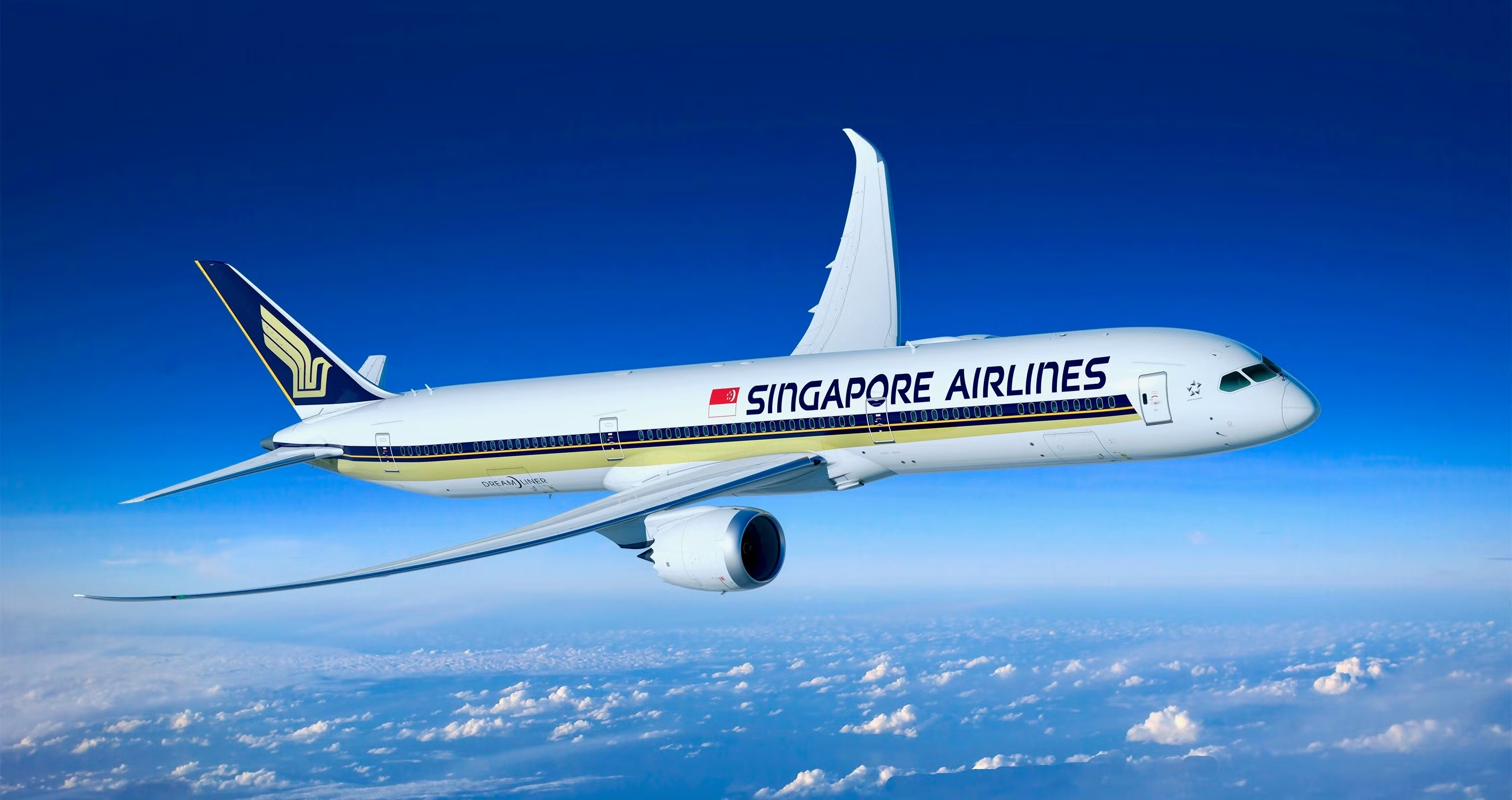
Singapore’s air transportation sector (SSIC 510) represents a critical backbone of the country’s position as a global aviation hub, connecting Southeast Asia with major international markets. Anchored by world-class infrastructure and leading carriers, the sector plays a pivotal role in passenger mobility, cargo logistics, and regional connectivity.
Between 2022 and 2024, the industry experienced a strong recovery trajectory, with revenue expanding significantly alongside a sharp turnaround in profitability following pandemic-induced losses. While topline growth reflects the normalization of global travel demand, underlying financial dynamics suggest a shift toward yield optimization, capacity discipline, and operational efficiency.
Despite the rebound, the sector remains structurally exposed to fuel costs, demand cyclicality, and global macro conditions, where earnings outcomes are increasingly shaped by network strategy, load factor management, and cost control rather than pure traffic growth.
Industry Snapshot 2024
Singapore’s SSIC 510 sector includes companies engaged in passenger and freight air transportation, spanning full-service carriers, low-cost airlines, and charter operations.
In 2024, the sector generated approximately USD 20.13B in Revenue, marking a strong increase vs. USD 16.88B in 2023 and USD 7.19B in 2022 — highlighting a full post-pandemic recovery and expansion phase.
Cost structure remains relatively lean compared to global airline benchmarks, with Cost of Goods Sold at USD 4.02B (~20% of revenue), reflecting Singapore’s operational efficiency and premium positioning.
Profitability indicators show a significant turnaround:
- Operating Profit reached USD 2.39B, up from USD 1.97B in 2023 and a loss of USD -0.54B in 2022
- Net Income stood at USD 2.16B, compared to USD 1.73B in 2023 and USD -1.08B in 2022
This sharp recovery aligns with broader industry trends, where global passenger traffic has returned to pre-pandemic levels and continues to grow, supported by strong travel demand and capacity expansion .
As of 2024, approximately 46 companies operate in this segment (stable vs. 2023), suggesting a concentrated and mature competitive landscape dominated by key national and regional carriers.
Overall, the sector demonstrates high operating leverage, where revenue recovery directly translates into profit expansion once fixed costs are absorbed. a favorable profitability trajectory, with earnings growing faster than costs — reinforcing its scalable, knowledge-driven operating model.
Industry Characteristics & Operating Landscape
Where do companies typically operate?
Air transportation activities in Singapore are highly centralized around Changi Airport, one of the world’s leading aviation hubs, serving as a strategic gateway between Asia, Europe, and Oceania.
Operations are globally oriented, with airlines focusing on long-haul international routes, regional connectivity within ASEAN, and transit passenger flows. Singapore’s geographic positioning enables it to function as a hub-and-spoke model, capturing both origin-destination and transfer traffic.
In addition, the ecosystem extends beyond airlines to include maintenance, repair & overhaul (MRO), cargo logistics, and aviation services, reinforcing Singapore’s integrated aviation cluster.ities, and private R&D centers, forming a multi-layered innovation network with strong regional clustering.
What drives demand in this sector?
Demand for air transportation in Singapore is primarily driven by international travel flows, tourism, and business mobility.
A key driver is the post-pandemic rebound in global travel demand, with airlines reporting strong passenger load factors and forward bookings across Asia-Pacific routes. Notably, major carriers have achieved record profitability, supported by robust passenger and cargo demand recovery .
Tourism and transit traffic play a critical role, as Singapore functions as a regional aviation hub rather than a purely domestic market. Growth in Southeast Asia’s middle class and increased accessibility via low-cost carriers further supports demand expansion.
At the same time, air cargo demand remains an important secondary driver, particularly during periods of global supply chain disruption, where air freight serves as a premium logistics solution.
However, demand remains sensitive to:
-Capacity additions leading to yield normalization
-Global economic cycles and travel sentiment
-Geopolitical developments and airspace constraints
What defines the operational model?
The air transportation sector operates under a high fixed-cost, high operating leverage model, where profitability is closely tied to capacity utilization and yield management.
Revenue is generated from passenger ticket sales, cargo services, and ancillary revenues (e.g., baggage, seat selection, onboard services). Increasingly, airlines are focusing on premium cabin offerings and ancillary monetization to enhance margins.
Cost structures are dominated by:
- Fuel expenses (highly volatile)
- Aircraft ownership and leasing
- Labor and maintenance
- Airport and navigation fees
Given the capital-intensive nature of the industry, airlines rely heavily on:
- Load factor optimization
- Dynamic pricing and yield management
- Fleet modernization for fuel efficiency
Emerging trends such as digitalization, biometric passenger processing, and sustainable aviation fuel (SAF) adoption are reshaping operational models, with Singapore introducing policy mechanisms to support decarbonization efforts .unities.
Interpreting 2022-2024 Performance
Sector-wide financial trends highlight a clear recovery and normalization cycle.
Revenue growth from 2022 to 2024 reflects the return of international travel demand and capacity restoration, while the sharp improvement in Operating Profit and Net Income indicates strong operating leverage effects.
The transition from losses in 2022 to strong profitability in 2024 underscores how airlines benefit disproportionately from demand recovery once fixed costs are covered.
At the same time, the stabilization in the number of companies suggests a mature industry structure, where scale, network strength, and brand positioning act as key competitive advantages.
Overall, the sector is moving into a post-recovery optimization phase, where growth is expected to moderate and profitability will depend more on efficiency and yield management rather than volume expansion alone.
What This Means for Investors
For investors, Singapore’s air transportation sector offers exposure to a strategically critical, globally integrated industry with strong recovery momentum and long-term growth potential.
Key considerations include:
• Exposure to global travel cycles and macroeconomic conditions
• Fuel cost volatility and hedging strategies
• Ability to maintain yield amid capacity expansion
• Hub competitiveness vs. regional aviation centers (e.g., Bangkok, Kuala Lumpur)
• Sustainability transition and regulatory costs (e.g., SAF adoption)
Value creation is increasingly linked to network optimization, premium positioning, and operational efficiency, rather than aggressive capacity expansion.
Singapore’s sector therefore represents a high-quality but cyclical investment landscape, where long-term upside is supported by structural growth in air travel, while short-term performance remains sensitive to global demand and cost dynamics.
About Datagent
Datagent is the trusted intelligence partner for company data and insights across Southeast Asia and beyond. We combine firmographics, financials, macro and micro economics into one integrated dataset — helping organizations uncover opportunities, assess markets, and make smarter, data-backed decisions across 11 dynamic economies.
Datagent provides a total of 61 firmographic data fields, comprising 22 non-financial, and 39 financial indicators with coverage spanning 2022–2024.
This report is for informational purposes only and does not constitute financial advice or an invitation to invest. Decisions should be based on independent research and professional consultation to avoid any unintended liabilities.