
WHAT PORT LOGISTICS COSTS VIETNAM IN 2026 – AND WHERE YOUR BUDGER WILL BREAK
Understanding real port logistics costs vietnam factors is critical for any enterprise entering Vietnam in 2026. Industry-standard tariff sheets suggest that moving a container through Vietnamese ports costs a predictable USD 120 to USD 155 per TEU. However, Datagent’s Q1 2026 supply chain audit tells a different story. Actual port logistics costs vietnam frameworks run 15% to 25% higher than those published figures.
The gap comes from secondary carrier margins, processing friction, and last-mile congestion premiums. As a result, the Northern corridor (Hai Phong/Lach Huyen) holds a structural 21% cost advantage over the Southern corridor (Cat Lai/Cai Mep). This difference is driven by expressway infrastructure that removes the idling penalties built into southern trucking rates.

1. The Disconnect: Why Your Landed Cost Models Miss Real Port Logistics Costs Vietnam
I have spent the better part of a decade helping institutional investors, corporate development teams, and industrial developers figure out what it actually costs to move volume through Southeast Asia and India’s logistics clusters. PE mandates running due diligence on Vietnamese manufacturing targets. Strategy consultants building expansion models for Fortune 500 clients. Family offices evaluating greenfield commitments in the “China+1” corridor. The common thread: nearly all of them arrive with a model for port logistics costs vietnam manufactures use underestimates reality by double digits.
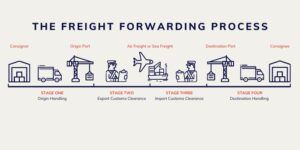
This diagram maps out the freight forwarding process split into four operational stages, highlighting the traditional cost components that mask the localized infrastructure premiums and regional variances between Vietnam’s Northern and Southern corridors.
Over the past three quarters, as supply chains decentralized under regional reconfigurations, a recurring executive failure has surfaced on our platform: the majority of corporate financial models for Vietnam greenfield expansion are built on structural illusions — tariff-sheet numbers that bear no resemblance to what actually hits the P&L.
These models fail because procurement teams evaluate markets based on published port tariff sheets. In Vietnam, a published tariff sheet bears roughly the same relationship to your actual operating cash outflow as a basic restaurant menu bears to a catered corporate dinner. They ignore the compounding carrier margins, localized congestion surcharges, and documentation friction that never appear on a baseline ocean freight quote.
When Cost of Goods Sold (COGS) consumes an average of 82% to 88% of gross revenues — a structural reality documented in our VSIC 30 sector analysis, where the sector recorded approximately USD 30.01 billion in revenue in 2024 with the number of active firms contracting from 2,257 to 2,107 in a single year — a persistent 10% to 15% logistics budget overrun is not an accounting variance. It is a direct erosion of your internal rate of return, turning a viable regional footprint into an underperforming asset.
To by pass the generic industry averages that ruin fiscal quarters, Datagent’s supply chain analytics team conducted a comprehensive field audit tracking 14 critical logistics nodes — spanning deep-water terminals, inland container depots (ICDs), bonded yards, and customs clearance hubs across the Northern and Southern corridors.
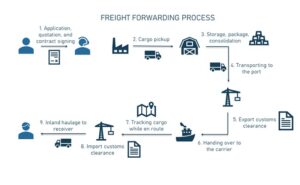
The complete end-to-end 9-step Freight Forwarding Process, detailing the entire critical path from contract signing through to complex multi-node ‘Inland Haulage’ and final delivery, essential for a fully comprehensive landed cost model
2. Port Logistics Costs Vietnam – Q1 2026 Field Dataset
To provide immediate, data-provenance backed clarity for investment committees and data analysts, the matrix below cuts beneath official regulatory filings — specifically Decision No. 4888/QĐ-CHP (Northern Cluster) and Decision No. 34/QĐ-TCTT (Southern Cluster) — to map the real landed cost of a single 40-foot container moving from discharge to a factory yard located within a standard 35-kilometer industrial park radius.
|
Landed Cost Element (40ft Container) |
Northern Corridor (Hai Phong / Lach Huyen) |
Southern Corridor (Cat Lai / Cai Mep) |
Structural Delta (%) |
Primary Operational Driver |
|
Real THC (Carrier Invoice Level) |
~USD 130 |
~USD 142 |
+9.2% |
ULCV infrastructure amortization vs. upstream double-handling |
|
Customs Brokerage & Inspection |
~USD 50 |
~USD 55 |
+10.0% |
HCMC bureaucratic volume density and agency concentration |
|
Median Demurrage (2-Day Friction) |
~USD 200 |
~USD 260 |
+30.0% |
Gating backlogs and localized document-matching delays |
|
Last-Mile Trucking (35 km Radius) |
~USD 70 |
~USD 84 |
+20.0% |
Peak-hour gate idling penalties and fuel burn economics |
|
BOT Infrastructure Tolls |
~USD 12 |
~USD 18 |
+50.0% |
Route-specific toll booth frequency on industrial arterials |
|
Total Real Landed Cost |
~USD 462 |
~USD 559 |
+20.9% |
Southern Corridor Congestion & Infrastructure Premium |
Dataset Provenance: Aggregated via Datagent Supply Chain Intelligence Platform, Q1 2026. Figures represent actual median corporate invoice line-items collected from active freight forwarders and tier-1 shippers across 14 terminal and inland logistics nodes. Demurrage models assume a conservative 2-day delay past standard 5-day carrier free-time allocations, which represents the current observed median friction point for specialized industrial imports. Official tariff baselines from Decision 4888/QĐ-CHP (Hai Phong) and Decision 34/QĐ-TCTT (Cai Mep).
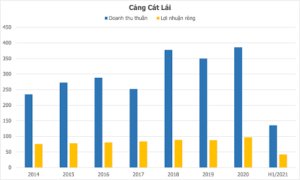
Historical revenue and net profit variance at Cat Lai Port, illustrating the high density of commercial margins embedded in the Southern cluster’s logistics framework.
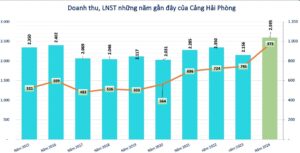
Financial trajectory and net profit performance of the Northern Port cluster through 2024, backing the structural scale advantages found in Lach Huyen and Hai Phong.
3. What Drives Port Logistics Costs in Vietnam: The 4-Layer Reality
3.1. Layer 1: Terminal Handling Charges (THC) — The Invoice Spread
The net terminal tariff mandated by the Ministry of Transport under Circular No. 39/2023/TT-BGTVT is a public number. But that is the rate charged to the ocean carrier, not to your balance sheet. The invoice that lands on your desk includes the shipping line’s administrative buffers, equipment positioning surcharges, and local VAT applications.
The Northern Reality: True market invoices hover between USD 120 and USD 145 per TEU. The deep-water berths at Lach Huyen anchor the lower bound due to automated gating systems. Older, upstream river terminals along the Cam River require barge double-handling, which drives up operational costs. The structural advantage here is documented in our Vietnam transport infrastructure analysis — direct expressway linkage eliminates the handoff friction that adds cost at every transfer point.
The Southern Reality: Market invoices range from USD 130 to USD 155 per TEU. The cost delta at Cai Mep is an infrastructure premium: the terminal accommodates ultra-large container vessels (ULCVs) up to 214,000 DWT, and amortizing that capital expenditure requires higher baseline fees. At Cat Lai, the premium functions simply as a localized inefficiency surcharge — too much volume through too few gates.
3.2. Layer 2: Customs Compliance & Specialized Inspection — The Binary Toll
Standard customs filings are highly predictable. The cost overruns occur when your cargo triggers specialized technical inspections — quality conformity checking, phytosanitary screening, or state valuations on industrial machinery.
This cost layer is strictly binary: if your product category or Harmonized System (HS) code triggers a statutory audit, you pay the full premium. If it does not, you skip the layer entirely. Using a generalized “customs average” in an expansion budget is a critical modeling error that I have watched destroy quarterly forecasts.
Our data shows that Southern inspection routes carry a 10% premium because of specialized agency concentration within Ho Chi Minh City, creating localized transport and processing queues that brokerage firms pass directly down to the importer. For the specific inspection and certification requirements that apply to each VSIC 30 sub-sector — shipbuilding, rail equipment, aerospace — our compliance guide for Vietnam manufacturing maps the regulatory triggers that determine whether your cargo hits this cost layer or by passes it entirely. These inspection triggers are among the most misunderstood components of port logistics costs vietnam importers face.
3.3. Layer 3: Demurrage & Detention — The Capital Dilution Engine
Demurrage and detention fees are theoretically entirely preventable. In practice, they are an everyday reality for unoptimized supply chains. When high-tech components or specialized raw materials experience even minor paperwork mismatches, customs clearance windows easily stretch 2 to 5 days past standard free-time limits.
In Q1 2026, real market penalties escalated aggressively:
- Northern Terminals: USD 80 to USD 120 per day post-expiration.
- Southern Terminals: USD 90 to USD 150 per day post-expiration.
Consider a case tracked by our platform: A tier-1 mechanical components manufacturer left a single Certificate of Origin (C/O) unverified before vessel arrival. The container sat at a Southern yard for 16 days during the verification loop, generating USD 2,400 in compounding demurrage. On an industrial cargo shipment valued at USD 18,000, that single administrative oversight acted as a 13.3% tax on cargo value — completely wiping out the projected margin for that production run.
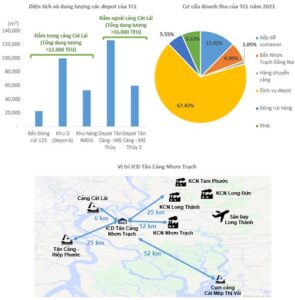
Spatial logistics analysis of the Southern cluster, detailing depot capacity bottlenecks and inland container depot (ICD) distances driving up last-mile trucking rates.
This is the cost layer where technology investment pays for itself fastest. The firms that have digitized their customs documentation pipeline — ensuring every C/O, inspection certificate, and carrier booking is verified before vessel arrival — reduce their demurrage exposure from the median 2-day friction to near zero. The practical tools and implementation sequence for building that pipeline are detailed in our logistics tech stack analysis for Vietnamese manufacturers.
3.4. Layer 4: Last-Mile Trucking — The Inefficiency Premium
For foreign enterprises scaling operations in Vietnam, the cost per kilometer of moving a container from a port terminal to an industrial park 40 kilometers away is frequently higher than the ocean freight rate per kilometer across major global trade lanes.
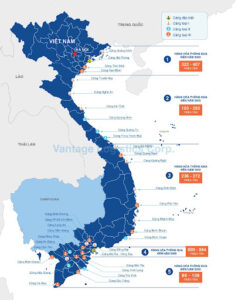
National maritime gateway mapping, framing the regional distribution layout for Datagent’s Q1 2026 cost index audit.
The Northern corridor’s cost advantage is structural, not cyclical. The Hanoi–Hai Phong Expressway connects the deep-sea berths at Lach Huyen directly to the major industrial clusters of Bac Ninh, Bac Giang, and Hai Duong without passing through dense urban centers.
Conversely, the Southern corridor lacks a fully integrated industrial arterial network. Container traffic routing from Cat Lai or Cai Mep toward Binh Duong and Dong Nai must navigate heavy commuter traffic and localized bottlenecks. Choosing the right carrier partner — one with established routes, gate-priority relationships, and fleet capacity rated for specialized cargo — can partially offset this structural friction. Our analysis of Vietnam’s major trucking companies profiles the operators with proven track records in the VSIC 30 heavy-industrial corridors.
Our field data at Cat Lai’s Nguyen Thi Dinh gating system clocked an average 45-minute idling delay per truck during standard peak hours (2:00 PM to 5:00 PM). This lost time translates directly into wasted fuel, reduced driver utilization rates, and lower daily truck rotation counts — costs that transportation firms build directly into their regional trucking rates.
4. Strategic Imperatives: How Port Logistics Costs in Vietnam Alter the P&L
When optimizing port logistics costs vietnam operations generate, corporate leadership must separate impactful operational changes from marginal procurement wins. After a decade of advising on Vietnam logistics, I have a clear view on which interventions actually move the needle — and which ones waste executive attention.
4.1. High-Impact Interventions (Verified ROI)
Pre-Arrival Document Matching. Transitioning your forwarders and compliance brokers into a shared digital verification pipeline allows you to audit and clear all customs files before the vessel berths. Shaving the median 2-day documentation friction down to zero saves an immediate USD 200+ per container in non-negotiable demurrage penalties. This is the single highest-ROI intervention available — it requires no capital expenditure, only process discipline. The implementation architecture is covered in our logistics technology analysis.
Intermodal Waterway Shifting. For non-time-sensitive component replenishment or volume staging, shifting containers via barge networks in the Southern corridor — linking Cai Mep deep-sea berths to inland ICDs in Dong Nai or Binh Duong — drops per-container transport costs by 20% to 35% compared to over-the-road trucking. The tradeoff is one to three additional transit days, which is often acceptable for VSIC 30 projects scheduled against multi-week production milestones.
Bonded Warehousing for Tariff Deferral. Under active trade frameworks like the CPTPP, EVFTA, and RCEP, managing the timing of your tax exposure is critical. Staging high-value imported inventory in bonded spaces defers customs duties and local VAT payments until the exact day the goods enter the domestic assembly line, significantly optimizing working capital velocity. This is particularly powerful in the VSIC 30 context, where milestone-based payment structures create natural cash flow timing pressures.
4.2. Low-Impact Traps: Where Procurement Teams Waste Time on Port Logistics Costs in Vietnam
Micro-Negotiating Baseline Carrier Rates. Procurement teams regularly spend weeks trading emails to secure a USD 5 discount on a carrier’s terminal handling charge, only to lose USD 500 in dockside demurrage because their underlying customs workflows are unoptimized. Rate cards are a secondary optimization lever; operational efficiency is the primary one.
Reactive Port Swapping. Shifting container volumes between Cat Lai and Cai Mep based on short-term trucking rate fluctuations often introduces hidden costs. It disrupts established equipment loops, fractures your existing customs broker alignment, and forces drivers into unfamiliar gate protocols, causing unexpected velocity drops. Port selection should be a strategic decision driven by your cargo profile and corridor infrastructure assessment, not a tactical response to marginal rate changes.
5. The Macro Perspective: Supply Chain Consolidation and What It Means for Your Entry Timing
Port logistics costs in Vietnam do not exist in a vacuum. They are a central factor in the industrial consolidation reshaping Southeast Asia’s manufacturing landscape.
The Vietnam Transportation Equipment Manufacturing sector (VSIC 30) lost 150 firms in a single year — from 2,257 in 2023 to 2,107 in 2024. The companies exiting are disproportionately those with uncontrolled logistics cost structures: firms that treated the gap between published tariffs and real landed costs as unavoidable overhead rather than an optimization target. The companies remaining are the ones that built cost visibility into their operating models and used it as competitive advantage.
As market competition intensifies, the enterprises protecting their margins are not doing so by forecasting price increases. They are doing so by using granular, field-level data to identify and eliminate structural cost leaks that their competitors accept as fixed.
Landed port ogistics costs Vietnam enterprises face are not a fixed expense. They are variable, highly sensitive to geography, and manageable — provided your corporate planning relies on live field tracking rather than generic industry averages.
If your financial model for Vietnam logistics is built on published tariffs, it is likely wrong by 15% to 25%. Book a 15-minute call with Datagent’s supply chain analytics team to receive a cost framework calibrated to your specific manufacturing footprint, import corridors, and cargo profile — the kind of ground-truth data that global terminals do not cover for Southeast Asian private markets. Or explore the DGENT Platform to start screening directly.
6. Frequently Asked Questions about Port Logistics Costs Vietnam
6.1. How much does it cost to ship a container within Vietnam in 2026?
The total real cost of moving a single 40-foot container from port berth to factory gate — including terminal handling, customs clearance, demurrage, and last-mile trucking within a 35 km radius — averages approximately USD 462 in the Northern corridor (Hai Phong/Lach Huyen) and USD 559 in the Southern corridor (Cat Lai/Cai Mep), based on Datagent’s Q1 2026 field data. This is 15% to 25% higher than what published tariff sheets suggest, because official rates exclude carrier invoice margins, inspection surcharges, and congestion-driven trucking premiums.
6.2. What are the hidden costs of importing into Vietnam?
Demurrage and detention charges are the largest hidden cost by a wide margin. For specialized manufacturing components that require statutory inspection, documentation delays routinely push customs clearance 2 to 5 days past the carrier’s free-time window — triggering daily penalties of USD 80 to USD 150 per container that escalate on a fixed schedule. In one case our platform tracked, a single unverified Certificate of Origin generated USD 2,400 in demurrage on an USD 18,000 shipment — a 13.3% tax on cargo value. The fix is not expensive: pre-arrival document verification eliminates this cost almost entirely.
6.3. Is Hai Phong or Ho Chi Minh City cheaper for importing?
For a standard container run with specialized cargo and a 35 km last-mile haul, the Northern corridor (Hai Phong/Lach Huyen) is approximately 17% to 21% cheaper than the Southern corridor (Cat Lai/Cai Mep). The gap is driven primarily by last-mile trucking costs: the Hanoi–Hai Phong Expressway provides direct, uncongested port-to-factory connectivity, while the Southern corridor forces container traffic through urban congestion that adds measurable cost per kilometer. However, the South offers deeper port capacity (Cai Mep handles vessels up to 214,000 DWT) and proximity to the country’s largest mechanical engineering cluster — so the right answer depends on your cargo profile and export routing.
6.4. How do I avoid demurrage fees in Vietnam?
The most effective single intervention is mandatory pre-arrival document matching: ensure every Certificate of Origin, inspection certificate, customs declaration, and carrier booking confirmation is uploaded, verified, and approved before the vessel reaches port. Firms that implement this workflow reduce their demurrage exposure from the observed median of 2 days to near zero — saving USD 200+ per container in non-negotiable penalties. This is a process discipline, not a technology investment, though implementing a digital logistics management system makes the process sustainable at scale.
6.5. Why are logistics costs so high in Vietnam?
Vietnam’s logistics costs account for approximately 16.8% to 17% of GDP — significantly higher than the global average of 10–11%. Three structural factors drive this: first, the gap between port infrastructure investment and inland transport connectivity, which creates bottlenecks at key gateways like Cat Lai (where our field data recorded 45-minute average truck idling times during peak hours); second, the fragmentation of the logistics provider landscape, with many small operators lacking the technology and scale for route optimization; and third, the layered fee structure where official terminal tariffs are marked up through multiple intermediaries before reaching the end-shipper. All three are addressable with the right data and operational strategy — which is why the firms surviving the current VSIC 30 sector consolidation are those that treat port logistics costs vietnam as a competitive advantage rather than unavoidable overhead.
6.6. How can manufacturers reduce port logistics costs vietnam-wide?
Three proven interventions, ranked by impact: (1) digitize your customs documentation pipeline to eliminate demurrage delays — this captures 40–50% of the available savings with minimal investment, (2) shift non-time-sensitive cargo to intermodal transport (barge in the southern corridor, rail in the north) for 20% to 35% per-TEU cost reductions, and (3) use bonded warehousing to defer customs duties and VAT payments until goods enter the production line, optimizing working capital timing under Vietnam’s CPTPP, EVFTA, and RCEP trade frameworks. The common mistake is starting with carrier rate negotiation — teams spend weeks securing a USD 5 THC discount while losing USD 500 in demurrage. Fix the process first, negotiate rates last.
Written by: Jey Nguyen, Senior Analyst at Datagent | [email protected]
About Datagent
Datagent is the trusted intelligence partner for company data and industrial insights across Southeast Asia and India. We integrate firmographics, verified corporate financial performance, and localized micro-economic indicators into a single, structured intelligence layer — helping institutional investors, multinational corporations, and strategy consultants mitigate supply chain risk and accelerate investment decisions across 11 dynamic economies.
Datagent delivers a total of 61 core firmographic fields, comprising 22 operational variables and 39 standardized financial indicators, with full historical coverage across 2022–2024.
This report is for informational purposes only and does not constitute financial advice or an invitation to invest. Decisions should be based on independent research and professional consultation.