
THAILAND REAL ESTATE INVESTMENT: THE MARKET ENTRY STRATEGY FOREIGN INVESTORS ACTUALLY NEED IN 2026
Developing a sound market entry strategy Thailand real estate is critical for any institutional investor, corporate development team, or family office evaluating thailand real estate investment exposure in 2026. Published guides on buying property Thailand foreigner suggest that accessing the market is straightforward: form a Thai entity, comply with the Foreign Business Act Thailand real estate restrictions, and deploy capital. However, Datagent’s Q1 2026 intelligence audit reveals that the actual thailand real estate investment framework creates operational complexities that generic guides systematically underestimate.
Thailand’s TSIC 68 sector recorded approximately USD 27.93 billion in revenue in 2024, with 2,667 active companies – down from 2,788 in 2022, as documented in our Thailand Real Estate Sector (TSIC 68). Understanding how to position within this consolidating landscape requires more than regulatory awareness – it demands ground-level data on where value is being created and destroyed across each thailand real estate sector (TSIC 68) corridor.
1. How to Approach Thailand Real Estate Investment: Why Most Models Underperform
I have spent the better part of a decade advising cross-border investors on what it actually takes to build a profitable thailand real estate investment position. PE funds structuring their first Thai property vehicle. Sovereign wealth mandates evaluating Bangkok condo investment foreigner strategies. Family offices converting tourism-driven vacation property interest into structured positions. The common thread: nearly all start with a model treating thailand real estate investment as a single, homogeneous market.
It is not. Thailand property market entry 2026 operates as at least four distinct investment environments, each with different thailand real estate investment rules, risk profiles, and property investment returns Thailand:
| Segment | Entry Vehicle | Foreign Own. | Min. Entry | IRR Range | Liquidity |
| Bangkok Condo | Direct / JV | Up to 49% | USD 150K-2M | 8-14% | 6-18 months |
| Commercial Office | JV / REIT | Via Thai entity | USD 10M-50M+ | 7-12% | 12-36 months |
| EEC Industrial | BOI / JV | Up to 100% | USD 5M-30M | 12-18% | 12-24 months |
| Resort / Hotel | Leasehold / JV | Leasehold only | USD 3M-25M | 6-15% | 18-36 months |
Dataset Provenance: Compiled via Datagent Investment Intelligence Platform, Q1 2026. IRR ranges reflect observed returns across tracked entries 2020-2024, adjusted for currency and normalized to USD.
2. Thailand Property Ownership Rules: What Foreign Investors Can and Cannot Own
2.1. Freehold Condominium Thailand: The Lowest-Friction Entry Point
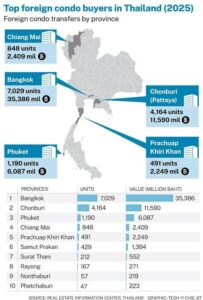
Freehold condominium Thailand ownership allows foreign individuals and entities to own units outright, subject to the 49% foreign ownership quota Thailand per registered building. This is the simplest pathway for Bangkok condo investment foreigner strategies. In 2024, foreign buyers completed over 14,500 condo transfers, with the funds required to originate from overseas and be declared for real estate purchase purpose at the receiving Thai bank. Property transfer fees Thailand 2026 for qualifying units valued under THB 7 million have been reduced from 2% to 0.01% under government stimulus measures effective through June 2026.
2.2. Joint Venture Thailand Real Estate: The Land-Based Development Path
For land-based development where direct foreign ownership is restricted under the Foreign Business Act Thailand real estate provisions, joint venture Thailand real estate structures are the most common pathway. The critical risk: our field data shows approximately 30% of cross-border JV structures experience governance disputes within 3 years, almost always due to insufficient real estate due diligence Thailand on the Thai partner’s financial position. Chanote title deed Thailand verification through the Land Department is essential, but prior encumbrances and easement rights require independent investigation.
2.3. BOI Promoted Investment Thailand Property: 100% Foreign Ownership
For EEC industrial real estate investment, BOI promoted investment Thailand property pathways allow 100% foreign ownership with tax incentives including 3 to 8-year corporate income tax exemptions. The BOI has streamlined LTR visa Thailand property investment processing from 60 to 30 days via new digital submission portals launched in January 2026. This is the strongest market entry strategy Thailand real estate for industrial and logistics-focused investors.
2.4. Leasehold Thailand Property: The 30-Year (and Potential 99-Year) Framework
Leasehold Thailand property arrangements remain capped at 30 years under the Civil and Commercial Code, with recent Supreme Court decisions invalidating automatic renewal clauses that attempted to extend beyond this period. In July 2024, the Thai cabinet approved extending to leasehold Thailand property 99 years for qualifying foreign investors, though implementation regulations remain pending as of Q2 2026. How to invest Thailand real estate via leasehold requires careful legal structuring given this regulatory uncertainty.

3. The 5-Stage Framework for Thailand Real Estate Investment Success
3.1. Stage 1: Segment Selection Using Thailand Real Estate Financial Data
Segment selection explains 60-70% of property investment returns Thailand variance. Use TSIC 68 sub-sector data to identify margin trends, such as analyzing developer operating efficiency detailed in our Thai developer EBITDA margins benchmarks. Currently, EEC industrial ventures and Bangkok luxury residential show the strongest risk-adjusted metrics for modern thailand real estate investment, whereas mid-market Bangkok condo strategies face headwinds from a 70% mortgage rejection rate.
3.2. Stage 2: Legal Structuring Under Thailand Property Ownership Rules
Structure selection directly impacts Thailand property tax foreign investor obligations, exit flexibility, and operational control. Each pathway under the Foreign Business Act Thailand real estate framework carries different implications for capital repatriation and dispute resolution, particularly when aligning with urban guidelines like Bangkok zoning laws during early thailand real estate investment planning.
3.3. Stage 3: Capital Deployment and Thailand Property Tax Considerations
First-time foreign investors should model first-project returns on an all-equity basis. Thai bank financing requires documented operating history. Mortgage rates ranged from 5.5% to 7.5% in 2024. Property transfer fees Thailand 2026 stimulus measures (0.01% versus standard 2%) create a time-limited entry incentive. Thailand property tax foreign investor structures benefit from double taxation agreements – evaluate withholding rates based on your home jurisdiction.
3.4. Stage 4: Real Estate Due Diligence Thailand Process
Real estate due diligence Thailand follows a different cadence than Western markets. Chanote title deed Thailand verification is essential but adds 4-8 weeks. Furthermore, land acquisition costs should always be cross-verified using advanced Thailand bank valuation methods. Datagent’s TSIC 68 database provides pre-screened developer profiles that streamline this phase of thailand real estate investment analysis by 40-60%.
3.5. Stage 5: Exit Planning for Thailand Real Estate Investment
Exit planning must begin at entry. Bangkok CBD condominiums offer 6-18 month exit windows; commercial assets require 12-36 months; land-based developments need 3-5 years. Evaluating structural exit options via Thailand REITs performance analysis provides alternative liquidity avenues for scaling any long-term thailand real estate investment portfolio.
4. Frequently Asked Questions
4.1. How can a foreigner invest in Thailand real estate in 2026?
Four primary pathways govern any successful thailand real estate investment:
- Freehold condominium purchase (49% foreign ownership quota Thailand per building);
- Joint venture structures with a Thai partner for land-based projects;
- BOI promoted entities for industrial assets offering 100% foreign ownership;
- Leasehold arrangements for resort properties. Each profile offers distinct risk-reward parameters for modern thailand real estate investment.
4.2. Can foreigners own land through Thailand Real Estate Investment?
Foreign individuals cannot own freehold land directly under current Thailand property ownership rules. Pathways include: leasehold Thailand property (30 years, with 99-year extension pending), BOI promoted investment Thailand property entities (can own land for promoted industrial activities), and joint venture Thailand real estate structures. The 49% foreign ownership quota Thailand applies to condominium buildings only, calculated by total floor area.
4.3. What is the minimum capital required for Thailand Real Estate Investment?
Minimum viable Thailand real estate investment varies: Bangkok condo investment foreigner from USD 150,000-300,000 per unit; joint venture Thailand real estate from USD 2-5 million equity; BOI promoted investment Thailand property from USD 5-10 million; diversified institutional portfolios from USD 15-25 million for adequate segment diversification.
4.4. What are the biggest risks of Thailand real estate investment in 2026?
Four primary risks:
- Demand compression from 70% mortgage rejection rates in mass-market;
- Bangkok mid-market condo oversupply;
- Regulatory uncertainty around leasehold Thailand property 99 years extension and Foreign Business Act Thailand real estate reforms;
- THB currency risk. Foreign investor Thailand property positioning with segment-specific intelligence and conservative leverage is best suited to navigate these headwinds.
4.5. What are property transfer fees in Thailand for foreign buyers in 2026?
Property transfer fees Thailand 2026 have been temporarily reduced: 0.01% transfer fee (vs. standard 2%) and 0.01% mortgage registration (vs. standard 1%) for properties valued under THB 7 million, effective through June 2026. Standard Thailand property tax foreign investor obligations include withholding tax on rental income, specific business tax (3.3% if sold within 5 years), and stamp duty (0.5%). Double taxation agreements may reduce effective rates depending on jurisdiction.
If your financial model for Thailand real estate is built on generic industry reports, it is likely missing the ground-level data that separates viable opportunities from underperforming assets. Book a 15-minute call with Datagent’s real estate analytics team to receive a framework calibrated to your specific investment thesis.
Written by: Jey Nguyen, Senior Analyst at Datagent | [email protected]
About Datagent
Datagent is the trusted intelligence partner for company data and industrial insights across Southeast Asia and India. We integrate firmographics, verified corporate financial performance, and localized micro-economic indicators into a single, structured intelligence layer – helping institutional investors, multinational corporations, and strategy consultants mitigate supply chain risk and accelerate investment decisions across 11 dynamic economies.
Datagent delivers a total of 61 core firmographic fields, comprising 22 operational variables and 39 standardized financial indicators, with full historical coverage across 2022-2024.